Current position — reviewed 22 August 2026
The guidance below still holds; only the year references have moved on.
- The live filing season is FY 2025-26 (AY 2026-27), with a due date of 31 July 2026 for individuals not subject to audit and 31 August 2026 for non-audit business and professional cases.
- The account nominated for a refund must be pre-validated on the e-filing portal, and the name on the account must match the PAN records.
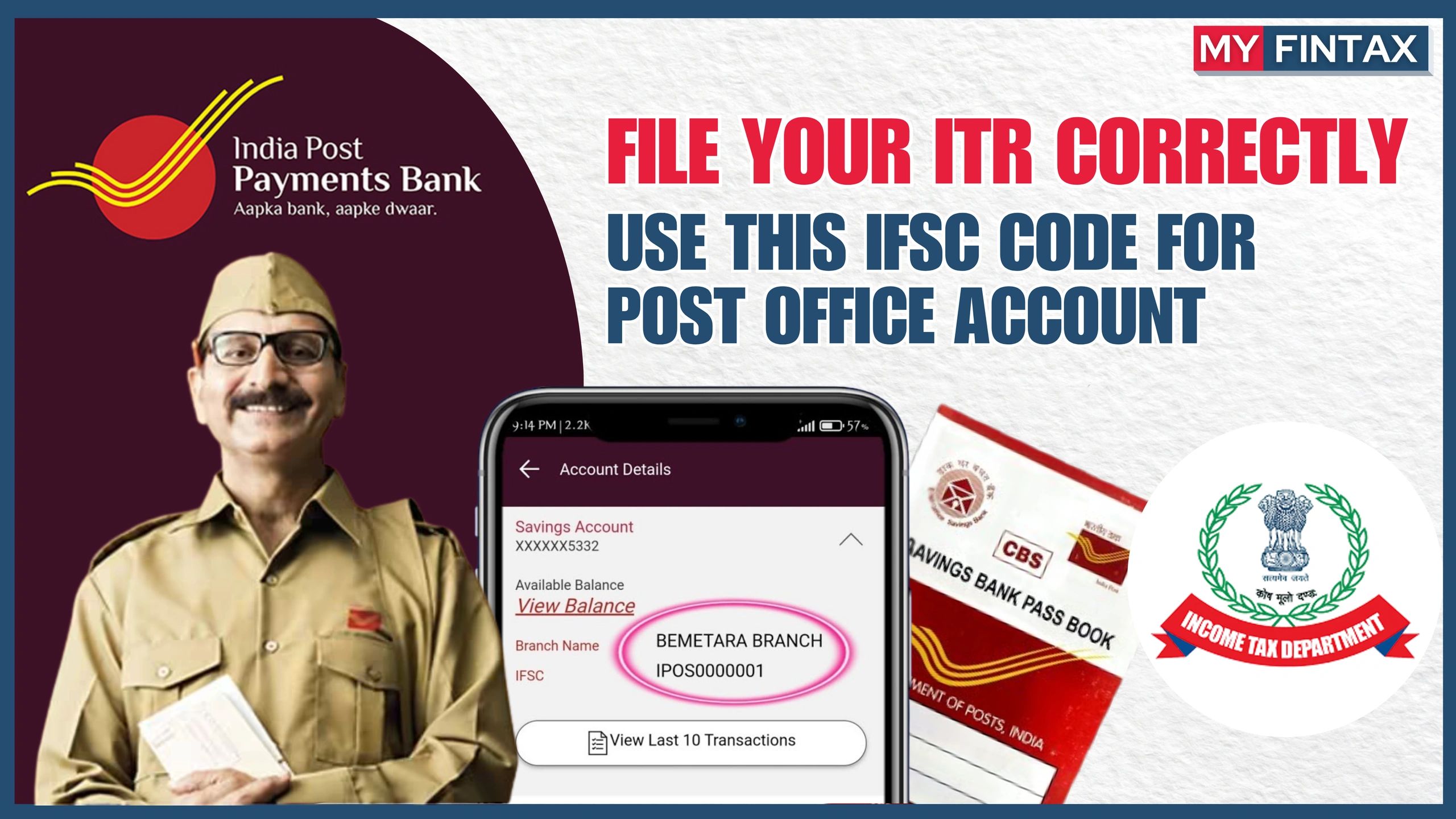
- For an India Post Payments Bank account, use the IFSC printed on your own passbook or shown in the IPPB app rather than a code quoted in a general article, since branch codes are revised from time to time.
Filing your Income Tax Return (ITR) and confused about which IFSC code to enter for your Post Office savings account? You're not alone.
Many taxpayers in India use India Post Payments Bank (IPPB) or traditional post office savings accounts, but when it comes to reporting bank account details in the ITR form, they are unsure which IFSC code to enter. This is crucial because the IFSC code is required to validate your bank account for income tax refunds and for other verification purposes.
In this article, we’ll clarify everything you need to know about using the correct IFSC code for your Post Office account while filing ITR for FY 2024-25 (AY 2025-26).
Why IFSC Code Matters in ITR Filing?
The Indian Financial System Code (IFSC) is a unique identifier for every bank branch that participates in the electronic payment system in India.
When filing your ITR, the income tax department requires your bank account details, including:
- Account Number
- Account Type
- IFSC Code
These details are essential for:
- Direct credit of income tax refunds
- E-verification of your ITR
- Ensuring no mismatch or delays in processing
Incorrect IFSC codes can lead to refund failures or rejection of the pre-validation process.
Types of Post Office Accounts & Their Reporting Issues
There are two main types of banking services related to post offices in India:
1. India Post Payments Bank (IPPB)
- It functions like any other commercial bank.
- It has its own IFSC code structure.
- Easy to validate online.
2. Traditional Post Office Savings Account
- Older type of savings account maintained at local post offices.
- May not always be compatible with NEFT/RTGS for refund credit.
- Not all accounts are on the CBS (Core Banking System).
Problem: These traditional accounts sometimes do not have a standard IFSC code associated with them, leading to confusion during ITR filing.
So, Which IFSC Code Should You Use?
If You Have an IPPB Account:
Use the standard IPPB IFSC code based on your branch. Example:
- IPPB Delhi Branch: IPOS0000001
- Format: IPOS0XXXXXX
You can find the exact IFSC code of your IPPB branch from:
- Your passbook
- Official IPPB website
- RBI’s IFSC directory
- Net banking platform (if enabled)
If You Have a CBS-Enabled Post Office Savings Account:
Use the IFSC code:
INDIPOSTCBS
(Used for accounts under CBS—Core Banking System)
However, this is not an officially recognized RBI IFSC code, and many tax filers report issues during bank account validation or refund credit using this.
Recommended Option:
If your post office account is not linked to a recognized IFSC code, it’s advisable to use a commercial bank account (SBI, HDFC, etc.) for receiving refunds.
Why You Should Avoid Using Non-Validated Accounts for Refunds
- Refunds may fail or bounce back.
- Processing will be delayed.
- You may receive a notice to update or correct account details.
- Refund may be credited via cheque in rare cases, causing further delay.
How to Check If Your Post Office Account is Valid for ITR?
- Go to the Income Tax Portal
- Log in and go to “Profile > My Bank Accounts”
- Click on “Add New Bank Account”
- Enter your post office account details and IFSC code
- The portal will show whether validation was successful or not
If validation fails, it’s better to use another account.
Expert Suggestion
If you're expecting a refund, it’s best to use a regular bank account that’s IFSC-enabled and NEFT/RTGS-compatible. Post office savings accounts, unless upgraded to IPPB or CBS-linked accounts, may create complications.
Summary: Which IFSC Code to Use?
- If you have an IPPB (India Post Payments Bank) Account:
- Use the branch-specific IFSC code (e.g., IPOS0000001).
- Fully valid and accepted for ITR filing and refund processing.
- If you have a CBS-enabled Post Office Savings Account:
- You may find IFSC like INDIPOSTCBS used unofficially.
- Validation may fail on the income tax portal.
- Use with caution—refund may be delayed or rejected.
- If you have a Non-CBS Local Post Office Account:
- No IFSC code is available.
- Not compatible with ITR filing or refund credit.
- Not recommended—use a commercial bank account instead.
Final Words
Entering the correct IFSC code in your ITR is a small step but has huge implications—especially when you're waiting for your refund. With the rise in digital processing and e-verification, it's more important than ever to use bank accounts that are fully compatible with the income tax system.
If you're unsure, switch to a verified commercial bank account for refund purposes, and avoid delays or missed payments.
Stay informed with @myfintaxofficial for expert insights on employment trends, taxation, and financial planning.


