Current position — reviewed 22 August 2026
The principle applied in this order continues to be followed. Where sales or consumption are accepted as genuine, only the profit element embedded in the disputed purchases is brought to tax, not the entire purchase value.
Tribunal benches and High Courts have continued to restrict additions to an estimated gross-profit element in such cases, and the Supreme Court has generally declined to interfere with those fact-based estimations.
The percentage applied is an estimation on the facts of each case, not a fixed statutory rate, so the figure in one order cannot be relied on as a benchmark.
The relief depends on the sales, stock and consumption records standing up to scrutiny; where the sales themselves are doubted, the outcome differs.
Assessments and appeals for years up to AY 2026-27 remain governed by the Income-tax Act, 1961; the Income-tax Act, 2025, in force from 1 April 2026, renumbers the corresponding provisions.
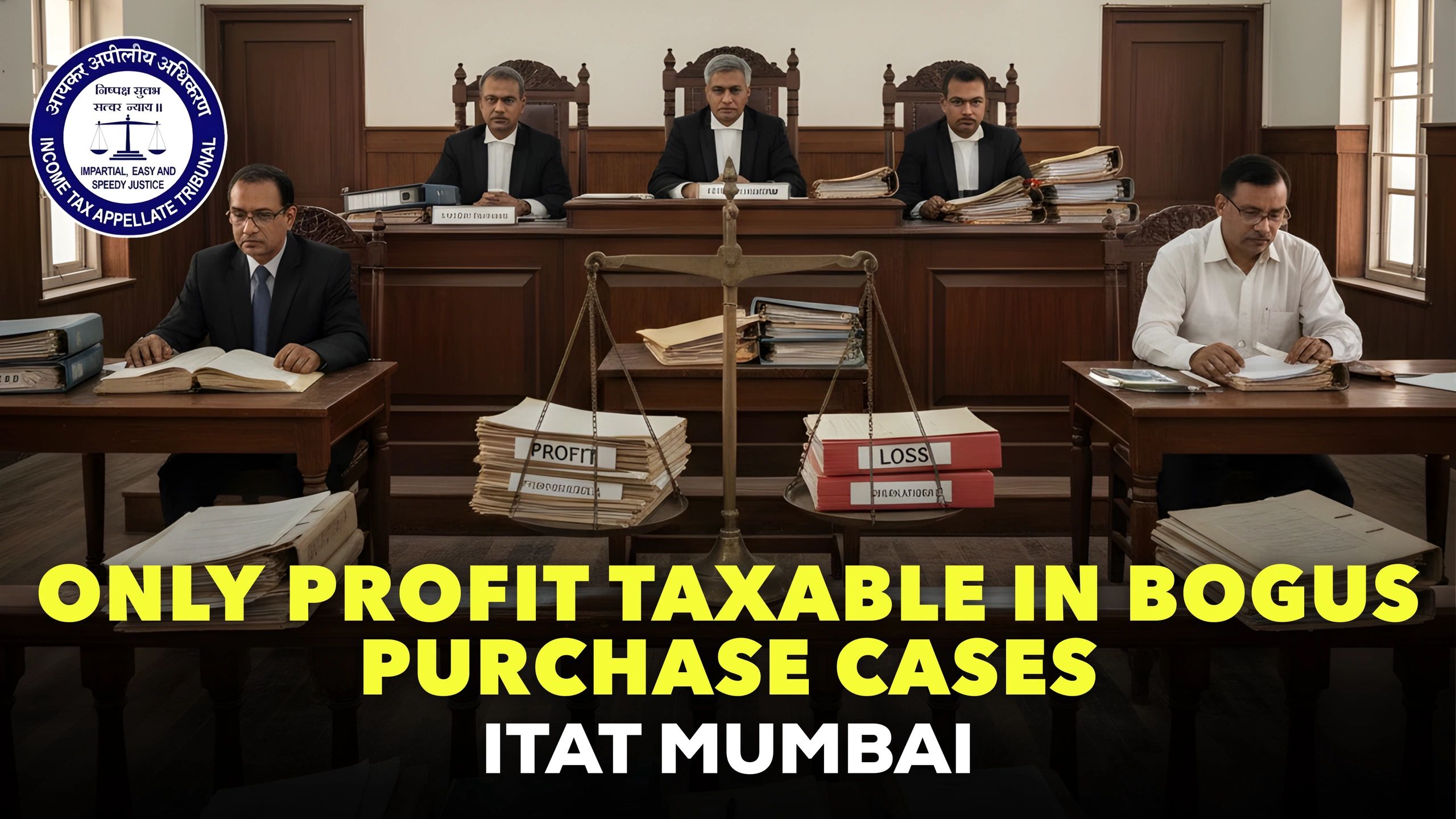
In a significant ruling that once again clarifies the legal position on alleged bogus purchase cases, the Income Tax Appellate Tribunal (ITAT), Mumbai, has held that only the profit element embedded in such purchases can be taxed, and not the entire purchase amount, when sales are accepted by the Assessing Officer.
Background of the Case
The case involved the assessee, Ashokkumar Kothari, against whom the Assessing Officer (AO) made additions based on information received from the DGIT (Investigation). The AO alleged that the assessee had obtained bogus purchase invoices amounting to ₹9,26,170 from three parties whose TINs were cancelled by the Sales Tax Department. These entities were suspected of providing accommodation entries without actual supply of goods.
The AO asked the assessee to produce documentary evidence to establish the genuineness of the purchases. The assessee submitted that all payments were made through proper banking channels. However, the AO was not convinced and noted that purchases from one of the parties had already been added in an earlier reassessment order.
Accordingly, the AO made an addition of ₹5,31,723 under Section 69C of the Income Tax Act in respect of purchases from the remaining two parties.
Proceedings Before the CIT(A)
The assessee challenged the addition before the Commissioner of Income Tax (Appeals) [CIT(A)]. Although the assessee did not appear during the appellate proceedings, the CIT(A) decided the matter on merits.
The CIT(A) observed that:
- The sales made by the assessee were accepted by the AO.
- When sales are accepted, the entire purchases cannot be treated as non-existent.
- At best, the assessee may have procured goods from the grey or open market and obtained accommodation bills.
Relying on various judicial precedents, the CIT(A) held that only the profit element embedded in the alleged bogus purchases can be brought to tax. The CIT(A) therefore restricted the addition to 20% of the alleged bogus purchases instead of the full amount.
Revenue’s Appeal Before ITAT
Aggrieved by the relief granted by the CIT(A), the Income Tax Department filed an appeal before the ITAT, Mumbai, contending that the entire purchase amount should have been disallowed.
The Revenue argued that since the suppliers were found to be bogus, the full value of the purchases deserved to be added to the assessee’s income.
ITAT’s Observations and Ruling
The ITAT dismissed the Revenue’s appeal and upheld the order of the CIT(A). The Tribunal made the following key observations:
- Once the sales are accepted, it cannot be presumed that the assessee made no purchases at all.
- In such cases, it is generally inferred that the assessee sourced goods from the grey market and obtained accommodation bills to regularize transactions.
- The real benefit derived by the assessee is limited to suppression of profit, savings on VAT/GST, or other incidental benefits, and not the entire purchase value.
The ITAT clearly held that:
Only the profit element embedded in the alleged bogus purchases can be taxed, and not the entire purchase amount.
Accordingly, the Tribunal confirmed the restriction of addition to 20% of the bogus purchases and dismissed the Revenue’s appeal.
Key Takeaway
This ruling reinforces a consistent judicial view that in cases of alleged bogus purchases:
- Acceptance of sales plays a crucial role
- Entire purchases cannot be disallowed outright
- Only the profit element embedded in such purchases is taxable
The decision provides much-needed clarity and relief to taxpayers facing additions solely based on accommodation entry allegations, where the existence of actual sales is not in dispute.


