Current position — reviewed 22 August 2026
The distinction explained below is evergreen. One tax point worth adding for Indian readers:
Intraday trading income is treated as speculative business income, F&O as non-speculative business income, and delivery-based holdings as capital gains — the classification, not the platform, decides how you are taxed.
The world of financial markets often promises freedom, wealth, and independence—but for beginners, it also hides one of the most expensive mistakes: confusing trading with investing.
Although both involve buying and selling financial assets, they are built on completely different foundations. When newcomers mix these two approaches, they end up making emotional decisions, chasing noise instead of strategy, and slowly damaging their financial goals.
Understanding the difference between trading and investing is not optional—it is essential.
Trading vs Investing: The Core Difference
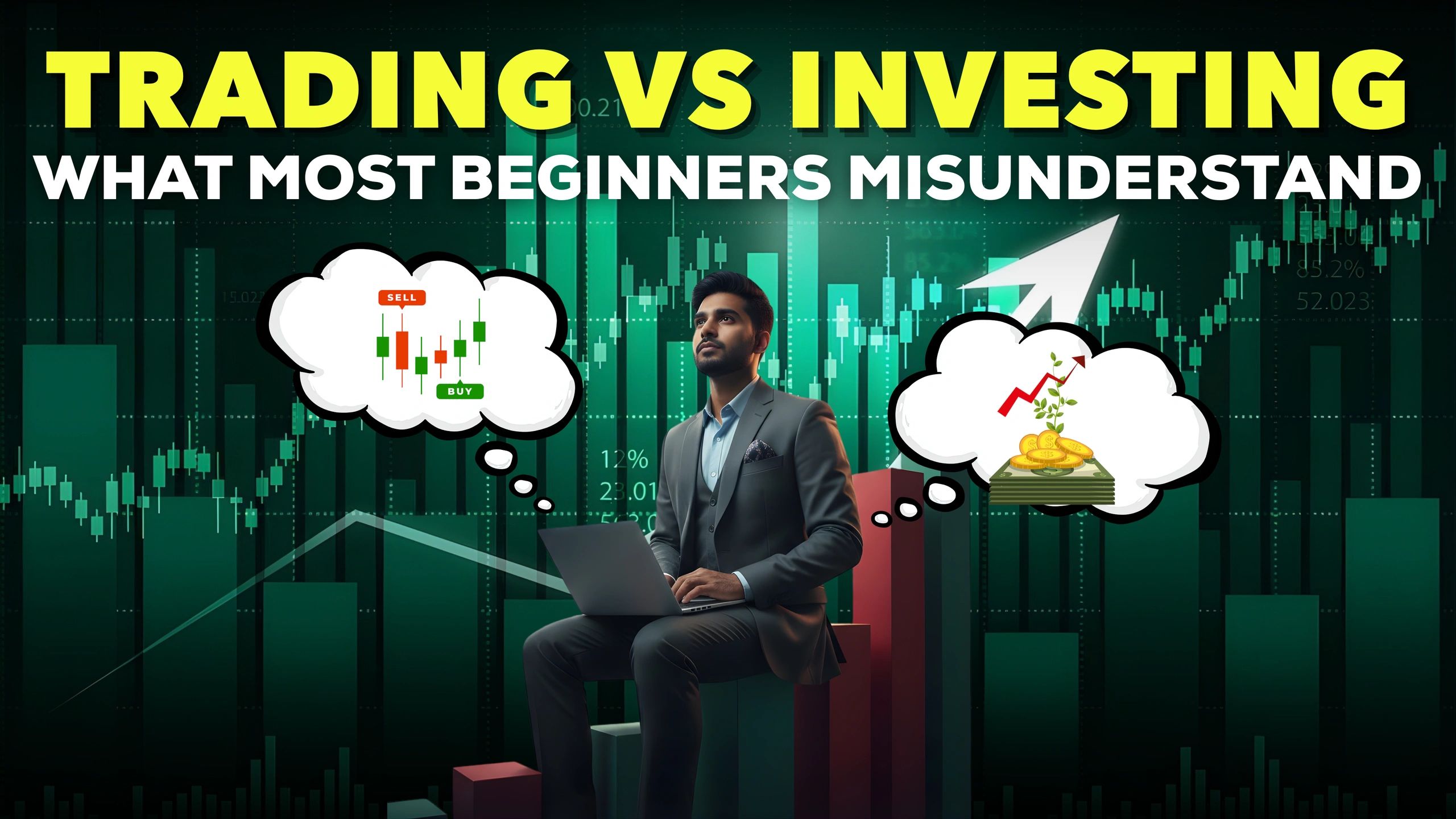
At the most basic level, the difference lies in time, intent, and mindset.
- Trading focuses on short-term price movements.
- Investing focuses on long-term wealth creation.
Traders are not interested in owning a business. They care about volatility, patterns, and momentum. Investors, on the other hand, care about the quality of a business, its future potential, and its ability to grow steadily over time.
What Is Trading?
Trading is the practice of buying and selling financial instruments—such as stocks, commodities, or currencies—over short periods ranging from minutes to weeks.
The goal is simple:
Buy at a lower price and sell at a higher price quickly.
Traders rely heavily on:
- Charts and technical indicators
- Price patterns and volume
- Strict entry and exit rules
- Risk management and stop-loss strategies
Because trades are frequent and price movements are unpredictable, trading carries high risk. Without discipline, even a few bad decisions can wipe out capital quickly. This is why trading demands constant attention, emotional control, and deep learning.
What Is Investing?
Investing is the act of putting money into assets with the expectation that they will grow in value over years or decades.
Investors buy assets such as stocks, bonds, or real estate and allow:
- Compounding to work
- Businesses to grow
- Dividends and reinvestment to build wealth
Investing relies on fundamental analysis, which answers questions like:
- Is the company profitable?
- Does it have strong leadership?
- Will its products or services remain relevant long-term?
Unlike trading, investing does not require daily monitoring—but it does require planning, patience, and periodic review.
The Most Common Beginner Mistakes
1. Reacting to Every Market Move
Many beginners invest for the long term but behave like traders during short-term market drops. Panic selling during temporary declines locks in losses and destroys compounding.
2. Treating Investing as “Buy and Forget”
Long-term investing is not careless investing. Portfolios need rebalancing, diversification, and occasional reassessment to stay aligned with goals.
3. Believing Trading Is a Shortcut to Riches
Social media highlights big wins but hides countless losses. Most beginners underestimate the difficulty of trading and overestimate their ability to beat the market quickly.
4. Assuming Markets Are Purely Random
Markets may be volatile, but they are driven by earnings, economics, interest rates, and human behavior. Successful strategies depend on understanding this structure.
Why Mixing Trading and Investing Fails
When you mix trading emotions with investing goals, you lose both advantages.
- Investors panic and sell during dips
- Traders refuse to exit losing positions
- Fees, taxes, and poor timing eat returns
Instead of growth, you get stress, inconsistency, and stagnation.
The solution is clarity.
How to Choose the Right Path
Choose investing if:
- Your goal is retirement or long-term wealth
- You prefer stability over excitement
- You want compounding to work in your favor
Choose trading if:
- You can dedicate time daily
- You enjoy analysis and structured rules
- You accept frequent losses as part of the process
You can do both—but never mix the money, mindset, or rules.
Final Thoughts
Trading and investing are not rivals—they are different tools for different objectives.
Beginners don’t fail because markets are unfair.
They fail because they use the wrong strategy for the wrong goal.
Once you clearly define whether you are a trader or an investor—and act accordingly—you give yourself a far better chance at building real, sustainable wealth.


